Train your AI smartly.
You have probably experienced it yourself. You land on a website, click the little chat bubble in the corner, type your question, and get back something completely useless. Maybe it sends you a link to a FAQ page you already checked. Maybe it says it does not understand and asks you to rephrase. Maybe it just keeps looping the same three options no matter what you type.
You close the chat and leave the website frustrated. Maybe you never come back.
Now here is the uncomfortable truth for business owners: that experience is happening on thousands of websites every single day. And in many cases, it is happening on YOUR website too.
Research shows that more than two thirds of customers have had a bad chatbot experience, with the most common complaints being that the chatbot could not answer their question and failed to understand what they actually needed.
But here is what that research also shows: the problem is almost never the technology itself. The problem is how most chatbots are built. Generic, disconnected from your business, and trained on nothing that actually matters to your visitors.
This blog breaks down exactly why most chatbots fail, and why a custom AI chatbot trained on your specific website content is a completely different story.
The Hard Truth: Most Chatbots Were Never Built to Know Your Business
When most companies add a chatbot to their website, they pick a tool, follow a setup wizard, and launch something that looks like a helpful assistant but is actually just a scripted bot wearing a disguise.
These generic chatbots operate on a simple principle: match a keyword to a pre-written response. Type the word "pricing" and get a pricing link. Type the word "support" and get a ticket form. Type anything more specific or natural and get a blank stare.
The problem is that real visitors do not talk in keywords. They ask questions like a human being would:
- Do you work with businesses in the healthcare industry?
- What happens after I sign up, how does the onboarding work?
- I already tried something similar and it did not work for me, why is this different?
A generic chatbot has no idea how to answer any of those questions because nobody ever told it anything specific about your business. It was never trained on your services, your process, your pricing, or your value. It is a blank tool pretending to be a knowledgeable assistant.
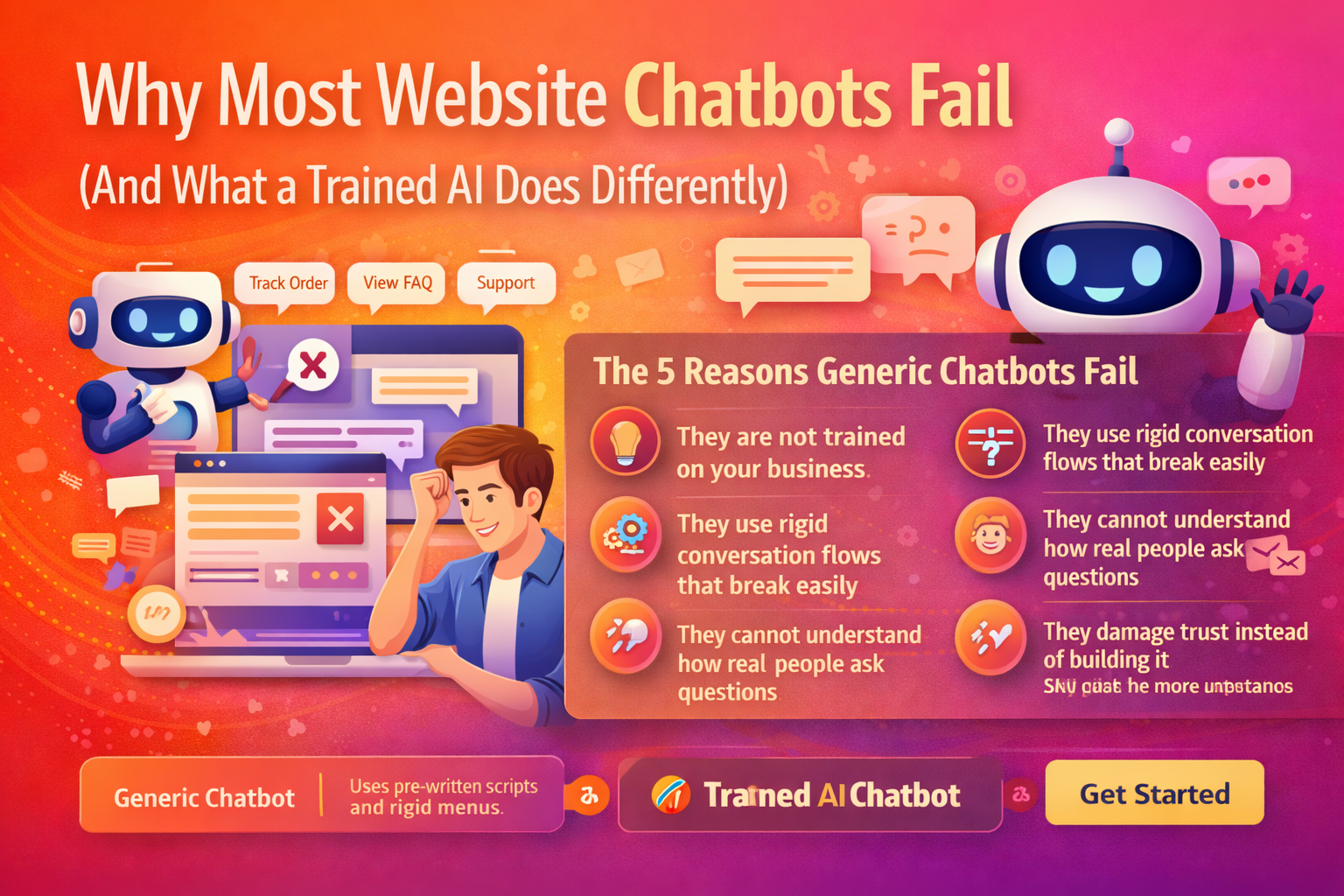
The 5 Reasons Generic Chatbots Fail
1. They are not trained on your business
A generic chatbot knows nothing about you. It has no idea what your services cost, who your ideal customer is, what makes you different, or how your process works. Without that foundation, every answer it gives is either too vague to be useful or just flat out wrong.
2. They use rigid conversation flows that break easily
Most chatbots are built around decision trees, a set of pre-defined paths that a visitor must follow. The moment a visitor asks something slightly outside those paths, the bot breaks. The result is confusion, dead ends, and a visitor who feels like they wasted their time.
3. They cannot understand how real people ask questions
People ask the same question in a hundred different ways. "How much does it cost?" and "What are your rates?" and "Is there a free plan?" all mean the same thing. A keyword-based chatbot may only recognise one of those phrasings. A trained AI understands all of them because it grasps the intent behind the words, not just the words themselves.
4. They damage trust instead of building it
A chatbot that gives wrong answers or loops endlessly does not just fail to help. It actively creates a bad impression of your business. Research shows that 53% of customers already find human agents more thorough than chatbots. A poorly performing bot reinforces exactly that belief and pushes visitors toward your competitors.
5. They become outdated the moment your business changes
Your pricing changes. You launch a new service. You update your process. A generic chatbot has no idea any of this happened. Unless someone manually updates every script and flow, the bot keeps giving visitors outdated information, which is sometimes worse than no answer at all.
What a Chatbot Trained on Your Website Does Differently
The difference between a generic chatbot and an AI chatbot trained on your website content is not a small improvement. It is a completely different category of tool.
Instead of following scripts, a trained AI chatbot reads and learns from your actual content: your service pages, your FAQs, your pricing, your case studies, your uploaded documents. Then when a visitor asks a question, it searches through everything it has learned and generates a conversational, accurate answer in real time.
- A visitor asks about your onboarding process: the chatbot answers with your actual onboarding steps, not a generic link
- A visitor asks if you work with a specific industry: the chatbot checks your content and answers accurately
- A visitor asks a question nobody anticipated: the chatbot still finds the closest relevant answer from your knowledge base
- Your content gets updated: the chatbot learns from the new version automatically
The result is a chatbot that sounds like it actually works for your company, because it does. Every answer comes from your content, your words, and your knowledge.
Generic Chatbot vs Trained AI Chatbot
The Business Cost of Getting This Wrong
It is easy to think of a bad chatbot as just a minor inconvenience. But the real cost to your business is much higher than most owners realise.
- Lost visitors: A visitor who gets a bad chatbot experience leaves and most of the time does not come back. That is a lead you spent money to acquire, gone.
- Damaged reputation: A frustrating chatbot tells visitors that your business does not value their time. That perception spreads through reviews and word of mouth.
- Increased support load: When the chatbot cannot help, visitors email or call instead. The automation you hoped would reduce workload ends up creating more of it.
- Missed conversions: Every visitor who leaves with an unanswered question is a conversion that did not happen. Multiply that by the number of visitors your site gets monthly and the cost becomes significant.
The good news is that all of these costs are avoidable. They are not the result of chatbot technology being bad. They are the result of the wrong kind of chatbot being used.
What Business Owners Who Tried Chatbots Before Need to Know
If you have tried a chatbot in the past and it did not work, you are not alone. Most businesses that tried early chatbot tools had a frustrating experience for exactly the reasons covered in this blog. The technology was generic, disconnected from their real content, and incapable of handling natural language.
That experience is valid. But it is not a reason to write off AI chatbots entirely. It is a reason to understand what went wrong and choose the right tool this time.
Talk2Site was built specifically to solve this problem. Rather than asking you to build a bot from scratch, it trains directly on your existing website content. Your pages, your FAQs, your documents become the knowledge base. The AI handles the rest.
No scripts to write. No decision trees to map. No developers to hire. Your website content does the teaching, and the AI does the talking.
How to Know If Your Current Chatbot Is Failing Your Visitors
- Visitors open the chat but close it within 30 seconds without getting an answer
- The chatbot regularly sends visitors to a human agent for basic questions
- You receive emails or calls asking questions that your chatbot should already be answering
- Visitors ask the same questions in different ways and get inconsistent responses
- The chatbot gives answers that are no longer accurate because your content has changed
If any of these sound familiar, the issue is not that a chatbot is a bad idea for your business. The issue is that the chatbot you are using was never properly trained on what your business actually does.
The Right Chatbot Is One That Actually Knows Your Business
Most chatbots fail not because AI does not work, but because they were never given the information they needed to succeed. A tool that knows nothing about your services, your process, and your customers cannot possibly help your visitors. It can only frustrate them.
A custom AI chatbot trained on your website is different from the ground up. It starts with your content. It learns your business. It answers your visitors the way a knowledgeable team member would.
The question is not whether chatbots work. The question is whether yours knows enough about your business to actually help.